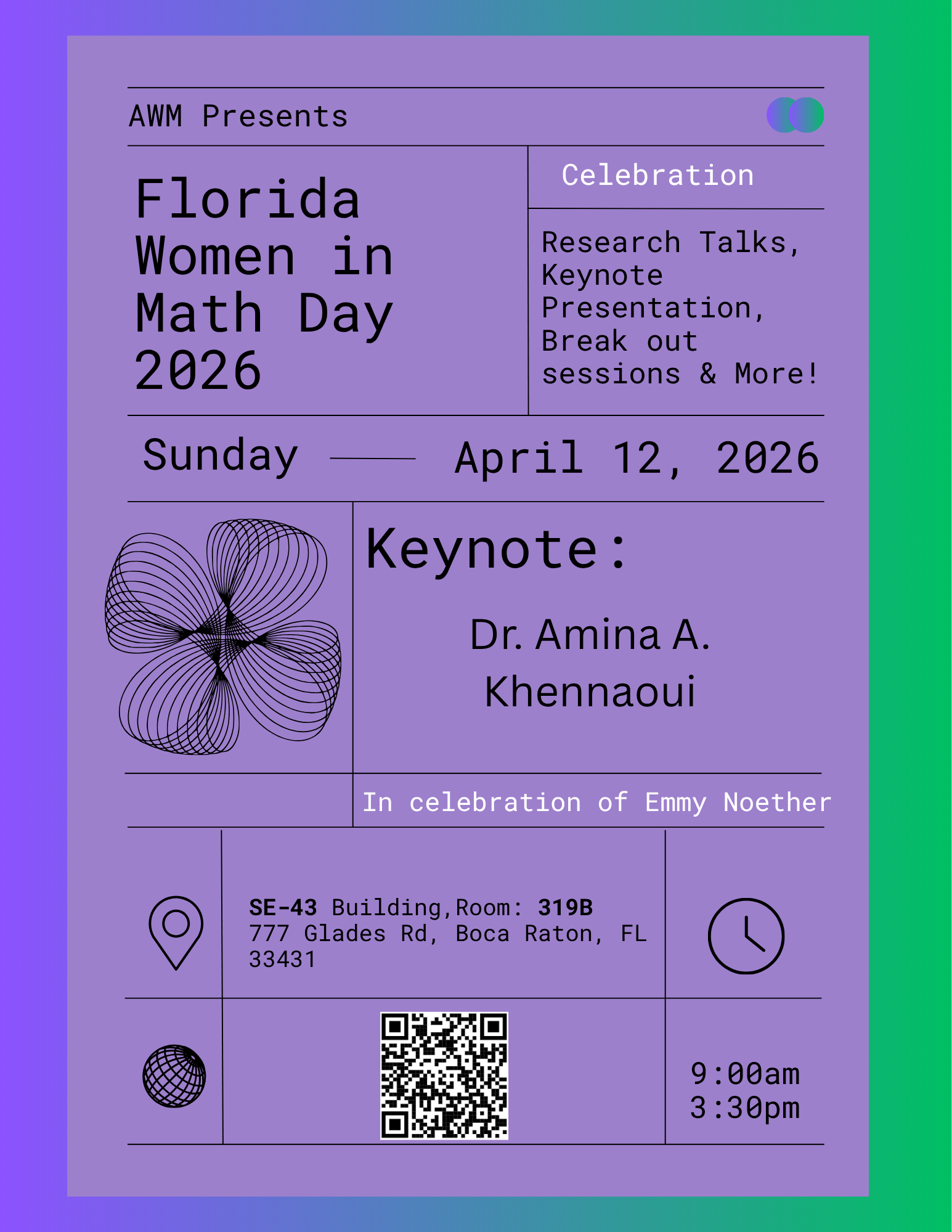
2025-26 Department of Mathematics and Statistics Events |
| Fall, 2025 |
August, 2025 |
|
August 3-7 |
CryptoTeens in South Florida Summer Camp Shaping the Future of Cybersecurity The "CryptoTeens in South Florida" is an exciting program tailored for talented high school students - boys and girls - who are passionate about mathematics, computer science, and cybersecurity. Open to all schools in the South Florida region (and beyond), the camp attracts a diverse group of participants and emphasizes a unique focus on cryptography, particularly the cutting-edge field of post-quantum cryptography. There is a participation fee of $90; however, scholarships will be available to fully reimburse students who successfully attend all five days of the program. If you have any questions, please feel free to contact the summer camp organizers at cryptoteens@fau.edu. |
|
August |
This summer camp offered by the faculty in the Cryptology/Cryptography, is a five - day camp for high-school students who want to discover the technology and the science behind cryptography. Participants will be introduced to the fundamental principles of c ryptography and learn how to apply conceptual knowledge to real-world situations. The camp will focus on Post-Quantum Cryptography, the area of math that is in charge of protecting our information in the era of quantum technology. The program includes stimulating lectures, inspiring talks by alumni and speakers from industry and government , and engaging exercise sessions. |
|
Tuesday |
Reading seminar on Quantum Algorithms This reading seminar is devoted to quantum algorithms, following Buchmann’s recently published book in the AMS series: <https://bookstore.ams.org/amstext-64> This seminar meets every other Tuesday, 10-10:50 AM in SE 215. If interested in participating, please email sicaf@fau.edu to subscribe to the crypto_math mailing list. * The schedule and topics of upcoming seminars can be found here: https://researchseminars.org/seminar/FAUcryptotopical |
|
Wednesday |
Riemannian manifolds reading group
Book: Lee. John M., Introduction to Riemannian Manifolds. ISBN: 978-3-319-91754-2 physical copy. Electronic access is available through the S.E. Wimberly Library. Join us for a weekly reading group! We will go through Lee's Introduction to Riemannian Manifolds. Anyone who's interested in joining us is welcome. For more information, please contact Prof. Parker Edwards . |
|
|
September, 2025 |
|
Tuesday |
Speaker: Hansraj Jangir, Ph.D. student, Florida Atlantic University Title: A Quasi-polynomial time Quantum Algorithm for the Extrapolated Dihedral Coset Problem. FLYER Abstract: The Learning With Errors (LWE) problem, introduced by Regev (STOC’05), is one of the fundamental problems in lattice-based cryptography, believed to be hard even for quantum adversaries. Regev (FOCS’02) showed that LWE reduces to the quantum Dihedral Coset Problem (DCP) and later, Brakerski et al. (PKC 2018) extended this to the more general Extrapolated Dihedral Coset Problem (EDCP). In this talk, we present a quasi-polynomial time quantum algorithm for solving EDCP over power-of-two moduli, using a quasi-polynomial number of samples. We stress that our algorithm does not affect the security of LWE with standard parameters, as the reduction from standard LWE to EDCP limits the number of samples to be polynomial. Bio: Hansraj is a PhD student in the Department of Mathematics and Statistics at Florida Atlantic University, Boca Raton. Prior to starting his doctoral studies, he worked as a Junior Research Fellow at the Defense Research and Development Organization (DRDO), Delhi. His research interests include lattice based cryptography and quantum algorithms. |
|
Wednesday |
Riemannian manifolds reading group
Book: Lee. John M., Introduction to Riemannian Manifolds. ISBN: 978-3-319-91754-2 physical copy. Electronic access is available through the S.E. Wimberly Library. Join us for a weekly reading group! We will go through Lee's Introduction to Riemannian Manifolds. Anyone who's interested in joining us is welcome. For more information, please contact Prof. Parker Edwards. |
|
Thursday |
Analysis and Applications Speaker: Lousi Merlin, Ph.D., Associate Professor, Florida Atlantic University, Department of Urban Planning Title: Finding the Right Formula for Land-Use Mix |
|
Friday |
Graduate Student Seminar Speaker: Addie Randolph, Florida Atlantic University Title: Invariant Circles of the Standard Map Abstract: Our goal with the following study is to lead to finding quasiperiodic orbits of the Circular Restricted Three Body Problem. A flow has quasiperiodic behavior if the associated Poincare map has quasiperiodic behavior. This encourages us to first look first at maps, and in this case, we look at a very well-known map, the standard map. An orbit exhibits Quasiperiodic behavior in a map if it is topologically conjugate to a rigid rotation of an irrational number. As given in the systematic recipe by Dr. Mireles James and David Blessing, we first compute the rotation number of the quasiperiodic orbit using the weighted Birkhoff averaging method. Then we use a Newton scheme to solve a conjugacy equation describing the circle resulting in the Fourier expansion of the quasiperiodic invariant circle. Finally, we observe the error of this method on multiple initial conditions. |
|
Tuesday |
Speaker: Nurdaulet Shynarbek, Mathematics Educational Program Coordinator (In-person) Title: Novel Representations of log 2 Through Polynomial Continued Fractions FLYER Abstract: This presentation explores new representations of the mathematical constant log 2 using polynomial continued fractions. Building on previous work in continued fraction theory, we investigate a conjecture by Zhu He which proposes a specific polynomial continued fraction for log 2. We will demonstrate the validity of this conjecture and introduce an infinite family of new polynomial continued fractions for log 2. |
|
Tuesday |
Speaker: Alibek Orynbassar, Senior Lecturer, Department of Pedagogy of Natural Sciences, SDU University Title: Complete Classification of Quadratic Irrationals with Period Two FLYER Abstract: This talk presents a full classification of quadratic irrationals whose continued fraction expansions have period length two. While it is known that the continued fraction of N is periodic, the distribution of period lengths is less understood. We establish precise conditions for the period-two case and illustrate the results with numerical examples. Bio: Alibek Orynbassar is a Senior Lecturer in the Department of Pedagogy of Natural Sciences at SDU University in Kaskelen, Kazakhstan, a position he has held since July 2023. He is currently pursuing a PhD in Mathematics and Natural Sciences at SDU. He earned both his Master’s (2017) and Bachelor’s (2014) degrees in Mathematics and Natural Sciences from SDU. From July 2022 to June 2023, he was a Visiting Scholar at Teachers College, Columbia University, where he expanded his expertise in mathematics education and research. Prior to his current role, he served as Mathematics Program Coordinator in the Department of Education at SDU (2020–2022) and as Senior Lecturer (2017–2022). Earlier in his career, he taught mathematics in secondary schools (2013–2017), where he prepared students for mathematics Olympiads. He has also contributed as a jury member for regional school mathematics Olympiads and scientific project competitions (2018–2020). |
|
Wednesday |
Riemannian manifolds reading group
Book: Lee. John M., Introduction to Riemannian Manifolds. ISBN: 978-3-319-91754-2 physical copy. Electronic access is available through the S.E. Wimberly Library. Join us for a weekly reading group! We will go through Lee's Introduction to Riemannian Manifolds. Anyone who's interested in joining us is welcome. For more information, please contact Prof. Parker Edwards. |
|
Tuesday |
Speaker: Dung Bui, LIP6, Sorbonne Université, France Title: FOLEAGE: F4OLE-Based Multi-Party Computation for Boolean Circuits FLYER Abstract: Secure Multi-party Computation (MPC) allows two or more parties to compute any public function over their privately-held inputs, without revealing any information beyond the result of the computation. Modern protocols for MPC generate a large amount of input-independent preprocessing material called multiplication triples, in an offline phase. This preprocessing can later be used by the parties to efficiently instantiate an input-dependent online phase computing the function. To date, the state-of-the-art secure multi-party computation protocols in the preprocessing model are tailored to secure computation of arithmetic circuits over large fields and require little communication in the preprocessing phase, typically O(N · m) to generate m triples among N parties. In contrast, when it comes to computing preprocessing for computations that are naturally represented as Boolean circuits, the state-of-the-art techniques have not evolved since the 1980s, and in particular, require every pair of parties to execute a large number of oblivious transfers before interacting to convert them to N-party triples, which induces an Ω(N^2 · m) communication overhead. In this paper, we introduce FOLEAGE, which addresses this gap by introducing an efficient preprocessing protocol tailored to Boolean circuits. FOLEAGE exhibits excellent performance: It generates m multiplication triples over F2 using only N · m + O(N^2 · log m) bits of communication for N-parties, and can concretely produce over 12 million triples per second in the 2-party setting on one core of a commodity machine. Our result builds upon an efficient Pseudorandom Correlation Generator (PCG) for multiplication triples over the field F4. Roughly speaking, a PCG enables parties to stretch a short seed into a large number of pseudorandom correlations non-interactively, which greatly improves the efficiency of the offline phase in MPC protocols. Our construction significantly outperforms the state-of-the-art, which we demonstrate via a prototype implementation. This is achieved by introducing a number of protocol-level, algorithmic-level, and implementation-level optimizations on the recent PCG construction of Bombar et al. (Crypto 2023) from the Quasi-Abelian Syndrome Decoding assumption. Bio: Dung Bui is a postdoctoral researcher at LIP6, Sorbonne Université, France. She completed her PhD at IRIF, Université Paris Cité. Her research interests are in various aspects of both practical and theoretical cryptography, including secure multiparty computation, zero-knowledge proofs, and post-quantum cryptography. Contact email: dung.bui@lip6.fr |
|
Wednesday |
Riemannian manifolds reading group Prof. Parker Edwards Book: Lee. John M., Introduction to Riemannian Manifolds. ISBN: 978-3-319-91754-2 physical copy. Electronic access is available through the S.E. Wimberly Library. Join us for a weekly reading group! We will go through Lee's Introduction to Riemannian Manifolds. Anyone who's interested in joining us is welcome. For more information, please contact Prof. Parker Edwards. |
|
Thursday |
Analysis & Applications Seminar Speaker: Dr. Ivan Sudakow Title: Modeling Critical Transitions in Complex Systems: From Local Interactions to Global Regime Shifts Abstract: When do local interactions trigger a global regime change, and how can we identify the mechanism? I present a Universal Dynamical Approximation (UDA) framework—parameterized universality for finite-dimensional, structurally stable dynamics—that places multiple model classes in a common normal form; in these coordinates, the bifurcation diagram yields reduced-order models. UDA is realized across reaction–diffusion systems, interfacial fluid flows, center–satellite network ODEs, and stochastic lattice spin models. Case studies include climate tipping points, ecosystem dynamics, evolutionary dynamics, and data-driven modeling supported by modern data analysis and interpretable machine learning. |
|
Friday |
Graduate Student Seminar Speaker : Mr. Ali Ittayem Title : Computational Methods for Identifying Chaotic Dynamics in the Sakarya System Abstract : In this work, we investigate the onset of chaotic dynamics in the Sakarya system through the construction and analysis of Poincaré maps. By computing periodic orbits on a chosen cross-section and evaluating the associated monodromy matrices, we extract the stability properties of these orbits and characterize the eigenvalue structure of the corresponding Poincaré return maps. The stable and unstable manifolds of hyperbolic periodic points are approximated using parameterization methods and iterative schemes, allowing for the detection of transversal intersections that signal the presence of Smale horseshoe dynamics. These results provide strong evidence for the existence of chaotic behavior in the Sakarya system, linking local manifold geometry to global dynamical complexity. Beyond offering a framework for analyzing this particular system, our methodology demonstrates how Poincaré maps serve as a powerful tool for identifying and verifying chaotic structures in nonlinear dynamical systems. |
|
Tuesday |
Analysis and its Applications Seminar Speaker: Youngsuk Ko who is currently at the Department of Epidemiology of Microbial Diseases, Yale School of Public Health, New Haven, USA Title: From Real-World Data to Decision-Ready Models for Public Health: Mathematical and Statistical Approaches Abstract: How can mathematical and statistical modeling, grounded in real-world data, inform public health policy—and what should we do when the data are messy? This talk presents a pipeline that connects individual-level records to population-level decisions across diseases. First, using COVID-19 as a case study, I build an event-level likelihood directly from individual confirmed-case records (e.g., onset and report dates, demographics) and use maximum likelihood to estimate parameters of a mechanistic model. This enables head-to-head evaluation of vaccine-prioritization policies under limited supply—for example, prioritizing older adults versus the general adult population. Second, for dengue in Brazil, I use catalytic models to recover age- and state-specific forces of infection and immunity profiles, then embed these estimates in an age-structured transmission model to assess allocation strategies when supply is constrained. The result is state-level susceptibility maps and decision curves that clarify where—and to whom—doses should go first. Throughout, I emphasize identifiability, transparent assumptions, and uncertainty quantification so that conclusions remain interpretable and reproducible. I close with brief directions for extending the same pipeline to other vector-borne and respiratory pathogens and to additional data streams. youngsuk.ko@yale.edu |
|
Wednesday |
Riemannian manifolds reading group
Book: Lee. John M., Introduction to Riemannian Manifolds. ISBN: 978-3-319-91754-2 physical copy. Electronic access is available through the S.E. Wimberly Library. Join us for a weekly reading group! We will go through Lee's Introduction to Riemannian Manifolds. Anyone who's interested in joining us is welcome. For more information, please contact Prof. Parker Edwards. |
|
Thursday |
Analysis and Applications Seminar Speaker: Yu Xiang https://sites.google.com/site/yuxianghomepage/home Title: Robust Learning from Heterogeneous Data Abstract: The theme of my talk will be principled robust learning from heterogeneous data, where the heterogeneity arises naturally from either distribution shifts or decentralized settings. In the first part, I will focus on learning under distribution shifts from a causal perspective. Distribution shift is arguably the main challenge in today’s machine learning where one has to apply predictors learned from one dataset to a new dataset with a different distribution. One principled approach is to adopt the structural causal models (SCMs) by Pearl to describe training and test models, following the invariance principle which says that the conditional distribution of the response given its predictors remains the same across environments. However, this principle is often violated in practice when the response is perturbed in the unseen environment. We introduce invariant matching property, an explicit relation to capture interventions through an auxiliary feature, enabling a unified treatment of general perturbations on the response as well as the predictors. I will discuss its connection to self-supervised learning (SSL) and non-stationary time series settings. The second part of my talk will be centered around multiple testing via false discover rate (FDR), a rich line of work initiated by statisticians such as Turkey and later popularized by Benjamini and his coworkers. Naturally suitable for large-scale data and distribution-free guarantees, the notion of false discovery rate control has played a critical role in many recent developments such as variable selection and uncertainty quantification. I will discuss decentralized settings where each agent collects a large number of local measurements for efficient and accurate global decision-making, motivated by internet of things and mobile sensor applications. We have developed the state-of-the-art methodologies with provable FDR guarantees and strong empirical performance. I will also briefly cover robust variable selection with FDR control and my recent work on adversarial robustness of conformal novelty detection. Bio: Yu Xiang is an Assistant Professor in Electrical and Computer Engineering at the University of Utah. Prior to this, he was a postdoctoral fellow in the School of Engineering and Applied Sciences at Harvard University. He obtained his Ph.D. in Electrical and Computer Engineering from the University of California, San Diego. He received his B.E. with the highest distinction from the School of Telecommunications Engineering at Xidian University in China. His current research interests include learning under distribution shifts from a causal perspective and efficient multiple testing for novelty detection in networks. |
|
Friday |
Association for Women in Mathematics (AWM) Student Chapter Join Us for Tea Time! Sip tea, matcha, spill some tea! FLYER We look forward to seeing you there! |
|
Tuesday |
Reading seminar on Quantum Algorithms This reading seminar is devoted to quantum algorithms, following Buchmann’s recently published book in the AMS series: <https://bookstore.ams.org/amstext-64> This seminar meets every other Tuesday, 10-10:50 AM in SE 215. If interested in participating, please email sicaf@fau.edu to subscribe to the crypto_math mailing list. * The schedule and topics of upcoming seminars can be found here: https://researchseminars.org/seminar/FAUcryptotopical |
|
|
October 2025 |
|
Wednesday |
Riemannian manifolds reading group Prof. Parker Edwards Book: Lee. John M., Introduction to Riemannian Manifolds. ISBN: 978-3-319-91754-2 physical copy. Electronic access is available through the S.E. Wimberly Library. Join us for a weekly reading group! We will go through Lee's Introduction to Riemannian Manifolds. Anyone who's interested in joining us is welcome. For more information, please contact Prof. Parker Edwards . |
|
Thursday |
Analysis & Applications Seminar Speaker: Prof. Erik Lundberg, Florida Atlantic University Title: A problem of Erdos on the area of lemniscates Abstract: Consider the sublevel set {|p(z)|<1} of the modulus of a monic complex polynomial p of degree n. This set is referred to as a lemniscate. G. Szego determined the maximal area of lemniscates in 1928. In 1940, P. Erdos posed the extremal problem of studying the minimal area when the zeros of p are in the closed unit disk. He restated and elaborated on this problem several times throughout his career. Pommerenke proved in 1961 a lower bound of order n^(-4) on the minimal area, and Wagner proved in 1988 an upper bound of order (log log n)^(-1/2). In this talk I will report on current joint work with M. Krishnapur, F. Nazarov, and K. Ramachandran showing that the minimal area has order (log n)^(-1). This resolves the specific questions and conjectures that were stated by Erdos on this problem. |
|
Friday |
Graduate Student Seminar Speaker: Sophie Faris Title: Introduction to Rigidity Theory Abstract: Rigidity Theory is the study of conditions that a geometry framework maintains its shape in a given space. This is done primarily using techniques from linear algebra. In this talk, I will be discussing the difference between equivalent and congruent shapes, and what makes a shape rigid. I’ll introduce a matrix called the rigidity matrix, and how to use said matrix to determine if a shape is rigid. Finally, a brief discussion on alternative approach, angular rigidity theory, where angles will be fixed versus the length as done in traditional rigidity theory. |
|
Tuesday |
Reading Seminar on Quantum Algorithms This reading seminar is devoted to quantum algorithms, following Buchmann’s recently published book in the AMS series: <https://bookstore.ams.org/amstext-64> This seminar meets every other Tuesday, 10-10:50 AM in SE 215. If interested in participating, please email sicaf@fau.edu to subscribe to the crypto_math mailing list. * The schedule and topics of upcoming seminars can be found here: https://researchseminars.org/seminar/FAUcryptotopical |
|
Wednesday |
Riemannian manifolds reading group Prof. Parker Edwards Book: Lee. John M., Introduction to Riemannian Manifolds. ISBN: 978-3-319-91754-2 physical copy. Electronic access is available through the S.E. Wimberly Library. Join us for a weekly reading group! We will go through Lee's Introduction to Riemannian Manifolds. Anyone who's interested in joining us is welcome. For more information, please contact Prof. Parker Edwards . |
|
Thursday |
Analysis and its Applications Seminar Speaker: Dr. Eric Lundberg Title: A problem of Erdos on the area of lemniscates (Part II)
Abstract: In this continuation of the previous talk, I will present some ideas in the proofs estimating the minimal area of lemniscates {|p(z)|<t} of a monic complex polynomial p of degree n, with particular attention on the case |
|
Saturday |
Applied Algebra and Cryptography Workshop Program Schedule University of South Florida and Florida Atlantic University welcome you to the Applied Algebra and Cryptography Workshop. As part of the NSF-funded Research Training Group in Applied Algebra, the Center for Cryptographic Research organizes the Florida Applied Algebra Days. These are a series of workshops featuring presentations on cryptography, coding theory, and quantum computing. From October 11 to 12, we will be hosting the second edition of the Applied Algebra Days at Florida Atlantic University. |
|
Tuesday |
Speaker: Anil Kumar Pradhan, Founding Cryptographer and Cryptography Research Lead, Vaultree Title: Beyond Theory: Industry Challenges in Adopting Homomorphic Encryption Abstract: Fully Homomorphic Encryption (FHE) promises quantum-resilient, privacy-preserving computation for sensitive data across industries. However, despite academic breakthroughs, the leap from laboratory models to enterprise-scale adoption remains daunting. Industry faces formidable obstacles, including computational resource demands, implementation complexity, slow processing speeds, and high costs, aggravated by a shortage of FHE talent and lack of standardized practices. Integrating FHE into legacy and cloud systems requires extensive technical overhaul, often with questionable ROI. The disconnect between academic solutions and practical business needs, especially regarding scalability, cost, and integration continues to deter widespread implementation. Emerging technologies and optimization strategies, such as hardware acceleration and real-world application benchmarking, may help bridge the gap, but genuine adoption will require collaborative efforts and a shift in focus from theoretical promise to operational feasibility. Bio Anil Kumar Pradhan is a cryptographer specializing in practical privacy-enhancing technologies and their deployment in real-world systems. At Vaultree, he works at the intersection of advanced cryptography and industry adoption, focusing on fully homomorphic encryption (FHE), encrypted machine learning, and secure computation at scale. With a background spanning both academic research and enterprise engineering, he bridges the gap between theoretical innovation and operational feasibility. Anil has contributed to projects that bring cutting-edge cryptographic methods into production environments, with particular attention to performance optimization, compliance, and developer experience. He is passionate about making strong cryptography usable, scalable, and impactful across industries that handle sensitive data. Anil Kumar Pradhan is the Founding Cryptographer and Cryptography Research Lead at Vaultree Ireland, and has over a decade of experience in applied cryptography. He holds an M.Sc. in Mathematics from the Indian Institute of Technology, Delhi, and a B.Sc. (Hons) in Mathematics and Computing from the Institute of Mathematics and Applications, Bhubaneswar. |
|
Wednesday |
Riemannian manifolds reading group Prof. Parker Edwards Book: Lee. John M., Introduction to Riemannian Manifolds. ISBN: 978-3-319-91754-2 physical copy. Electronic access is available through the S.E. Wimberly Library. Join us for a weekly reading group! We will go through Lee's Introduction to Riemannian Manifolds. Anyone who's interested in joining us is welcome. For more information, please contact Prof. Parker Edwards . |
|
Thursday |
Analysis and its Applications Seminar Speaker: Dr. Joan Gimeno, Universitat de Barcelona Title: Periodic Collinearity Orbits: A First Look
Abstract:
Periodic syzygy orbits -trajectories that force celestial bodies to become collinear on a repeating schedule- may offer a sharp lens on exoplanet dynamics. Syzygies and collinear states trace back to Euler (1765) and Lagrange (1772). Building on Poincaré's periodic solutions (1890s), subsequent regularization and continuation advances (Levi-Civita, Sundman, McGehee), and systematic numerical and stability studies by Hénon and Broucke (1970s). |
|
Thursday |
Graduate Student Seminar Speaker: James Klinkenburg, Ph.D. Student, Florida Atlantic University Title: Introduction to Frame Theory Abstract: When studying a topological space, one is typically concerned not only with the open sets of the topology, but also the points of the space. For example, the Hausdorff condition states that any two points in the space can be separated by disjoint open sets. Sometimes, however, it is wise to look at things from a different angle by discarding the points and simply look at the open sets. It turns out that the open sets of a topology form what is known as a frame. In this talk, we will explore the basics of frame theory, starting by defining a frame as a complete lattice that satisfies a strong distributive law. We will define concepts such as compact and prime elements, algebraic frame, and the finite intersection property. We will explore examples of frames coming from topological spaces, lattice-ordered groups, and commutative rings with identity. Finally, time permitting, we will explore what current research in this area looks like by looking at the Lemma on Ultrafilters. |
|
Friday |
Colloquium Speaker: Luke Peterson, Department of Aerospace Engineering, University of Texas, Austin Title: Celestial Mechanics Problems in Cislunar Space
Abstract: Cislunar space-the region between Earth and the Moon-has reemerged as a critical area for space exploration. From a mathematical perspective, this region is governed by multi-body dynamics that give rise to rich structures, including invariant manifolds, resonant orbits, and homoclinic chaos. This talk will introduce classical and modern tools from celestial mechanics to analyze motion in the Earth-Moon system, with an emphasis on restricted 3- and 4-body problems. We will discuss how perturbative methods (normal forms) and invariant manifold theory (parameterization method) reveal the underlying organization of the phase space. Particular attention will be placed on connecting the perturbative regime, where classical methods apply, with the realistic system, which often lies far outside that regime, using computer-assisted techniques. Our ultimate goal is to establish rigorous results for the real solar system while enhancing the engineering capabilities needed to design and fly missions, highlighting how mathematics contributes both to theory and to the practical challenges of contemporary space exploration. |
|
Tuesday |
Reading Seminar on Quantum Algorithms This reading seminar is devoted to quantum algorithms, following Buchmann’s recently published book in the AMS series: <https://bookstore.ams.org/amstext-64> This seminar meets every other Tuesday, 10-10:50 AM in SE 215. If interested in participating, please email sicaf@fau.edu to subscribe to the crypto_math mailing list. * The schedule and topics of upcoming seminars can be found here: https://researchseminars.org/seminar/FAUcryptotopical |
|
Wednesday |
Riemannian manifolds reading group Prof. Parker Edwards Book: Lee. John M., Introduction to Riemannian Manifolds. ISBN: 978-3-319-91754-2 physical copy. Electronic access is available through the S.E. Wimberly Library. Join us for a weekly reading group! We will go through Lee's Introduction to Riemannian Manifolds. Anyone who's interested in joining us is welcome. For more information, please contact Prof. Parker Edwards . |
|
Thursday |
Analysis & Its Applications Seminar Speaker: Lue Peterson, University of Texas, Austin Title: Melnikov Methods in Realistic Solar System Models: Resonant Orbits & Homoclinic Phenomena Abstract: Cislunar space—the region between Earth and the Moon—has reemerged as a critical area for space exploration. From a mathematical perspective, this region is governed by multi-body dynamics that give rise to rich structures, including invariant manifolds, e.g., resonant orbits and homoclinic connecting orbits. In the cislunar region of the solar system, understanding the dynamics of a satellite or asteroid necessarily involves incorporating perturbations from periodic forces (e.g., gravity of the Sun, ellipticity, inclination) to the restricted 3-body problem. As resonant and connecting orbits help to govern global dynamics of a system, studying their persistence under periodic perturbations is key to understanding this region of the real solar system. In this talk, we employ Melnikov methods, both subharmonic and homoclinic, to study the persistence of resonant and homoclinic orbits under periodic forcing. We will see how the subharmonic Melnikov method reduces the persistence problem to a simple integral computation à la single-variable calculus. Further, by means of continuation into the Sun-Earth-Moon system, we will show that the resonant orbits and homoclinic phenomena are directly related. Finally, we will discuss the relationship between the Melnikov and parameterization methods for invariant manifolds, and how they can be used to set up readily replicable computer-assisted proofs. |
|
Monday |
Ph.D. Defense Speaker: David Snyder, Ph.D. Candidate Title: Representation Theory of Algebras: Classification of systems of two invariant subspaces Abstract: Click Here A copy of the dissertation is on display in SE 234. |
|
Tuesday |
Speaker: Dr. Sohyun Jeon, Ewha Womans University Title: LastRings: Lattice-based Scalable Threshold Ring Signatures FLYER
Abstract:
This talk presents the first lattice-based threshold ring signature scheme with signature size scaling logarithmically in the size of the ring while supporting arbitrary thresholds. Our construction is also concretely efficient, achieving signature sizes of less than 150kB for ring sizes up to N=4096 (with threshold size T=N/2, say). This is substantially more compact than previous work. |
|
Wednesday |
Riemannian manifolds reading group Prof. Parker Edwards Book: Lee. John M., Introduction to Riemannian Manifolds. ISBN: 978-3-319-91754-2 physical copy. Electronic access is available through the S.E. Wimberly Library. Join us for a weekly reading group! We will go through Lee's Introduction to Riemannian Manifolds. Anyone who's interested in joining us is welcome. For more information, please contact Prof. Parker Edwards . |
|
Thursday |
Analysis & Its Applications Seminar Speaker: Robert Lubarsky, Ph.D., Florida Atlantic University Title: The Ultraproduct Construction Abstract: Ultraproducts are a way of averaging a family of structures of the same type (e.g. a collection of groups, or a collection of metric spaces). Surprisingly, even though the construction has an algebraic feel, and is useful throughout mathematics, it seems not to be well known beyond logicians. This talk will give the basic definitions and results behind the ultraproduct, and applications to logic, algebra, analysis, and set theory. |
|
Friday |
Graduate Student Seminar Speaker: Christian Corbett, Ph.D. Student, Florida Atlantic University Title: Introduction to theorem proving in Lean 4 Abstract: Large language models have recently started showing flashes of mathematical insight (which still feels a little uncanny), and much of that talent seems to come from how well they handle formal languages like Lean 4, where math and programming finally stop pretending they’re different things. Lean 4 is a modern theorem prover (think of it as a calculator for proofs, except it yells at you until you’re right) that lets us build mathematics from the ground up with total precision. In this talk, I’ll walk through what Lean actually is, how it works, and why it’s both more intuitive and more philosophical than it first appears. We’ll see how a few lines of code can define a structure, prove a theorem, or perhaps completely crash the program, and I’ll wrap up by showing a bit of my own work in lattice theory. Come and enjoy the talk, time with colleagues, and donuts! Happy Halloween! |
|
|
November 2025 |
|
Monday |
Ph.D. Dissertation Defense Speaker: Tran Ngo, Ph.D. Candidate, Florida Atlantic University Title: Post-Quantum Cryptology: New Constructions and Cryptanalysis Abstract: Classical cryptographic schemes, which are based on the hardness of factorization and discrete logarithmic problems, can be efficiently solved by the Shor algorithm on a quantum computer. This motivated the 2016 National Institute of Standards and Technology (NIST) call to identify efficient and secure cryptographic schemes that are resilient to potential attacks from both classical and quantum adversaries, a field referred to as post-quantum cryptography. In this work, we focus on designing efficient post-quantum cryptographic primitives based on code-based and lattice-based assumptions, and we analyze their underlying hardness using quantum cryptanalysis. On the construction side, we propose a ring signature scheme and an identity-based signature scheme based on the Code Equivalence Problem, leveraging the LESS identification scheme and the Calamari-Falaflframework. The proposed ring signature achieves small public keys (11.57 kB), and its signature size grows logarithmically with the number of users in the ring, outperforming existing code-based solutions while remaining competitive with other post-quantum schemes, particularly for large ring sizes. Furthermore, we introduce cryptographic schemes based on the Module v NTRU problem, a generalization of the NTRU problem that provides better flexibility in parameter selection. Building on this, we design compact encryption schemes that achieve a low decryption failure rate, with a proposed parameter set offering the smallest ciphertext size among NIST Level 3 security schemes. Additionally, we present the design of signature schemes, one of which achieves the smallest provably secure signature size in the Quantum Random Oracle Model (QROM). On the cryptanalysis side, we present a concrete quantum resource estimation for lattice enumeration based on Montanaro’s algorithm, together with a detailed implementation in the quantum circuit model, and show how to optimize the depth of the circuit through parallelized design components. The second contribution is a quasi-polynomial-time algorithm for the Extrapolated Dihedral Coset Problem (EDCP) over power-of-two moduli. Although our results on EDCP do not compromise the security of LWE with standard parameters, they offer insight into the complexity of LWE. All are welcome! A copy of Tran Ngo's dissertation can be found in SE 234 |
|
Wed. |
Math Competition for High School Students (AMC 10/12A) The Mathematical Association of America hosts the annual AMC contests for middle and high school students. We began the AMC10-12 Contests in as early as 2007. Its purpose is to spur interest in mathematics and develop talent through the excitement of friendly competition at problem-solving in a timed format. |
|
Wed. |
Riemannian manifolds reading group Prof. Parker Edwards Book: Lee. John M., Introduction to Riemannian Manifolds. ISBN: 978-3-319-91754-2 physical copy. Electronic access is available through the S.E. Wimberly Library. Join us for a weekly reading group! We will go through Lee's Introduction to Riemannian Manifolds. Anyone who's interested in joining us is welcome. For more information, please contact Prof. Parker Edwards. |
|
Thursday |
Analysis and Applications Seminar Speaker: Francesco Sica, Ph. D., Florida Atlantic University Title: History of the Bernstein Problem Abstract: Bernstein’s problem asks whether the graph of a function u, defined over all of ℝ^n, and satisfying the Euler-Lagrange equation for minimal surfaces, is a hyperplane. Bernstein himself gave in 1915 a positive answer when n=2. The problem was then solved for 3⩽n⩽7 only in the sixties, with the widely believed result being conjectured for all n. Then, in 1969 a remarkable paper by Bombieri, De Giorgi and Giusti showed that Bernstein’s problem has a negative answer for all n⩾8. I will present an elegant proof of the original Bernstein theorem and discuss its fascinating history. The only prerequisite is Calc 3 and Cauchy’s theory of holomorphic functions. |
|
Wed. |
Master of Science in Teaching Mathematics (MST) Defense Speaker: Colette Chilton-Carr, MST candidate Title: Historical Contexts in Mathematics Education: Improving Student Engagement and Achievement Abstract: There are many informational gaps in contemporary mathematics education. Students see the mathematical topics they are being taught as facts and procedures unrelated to each other or to themselves as mathematicians. Many ancient developments in the realm of mathematics are still relevant today, showcasing the needs that motivated their longstanding evolution. By including the stories behind the formulas in mathematics classrooms, students from diverse backgrounds can feel seen and connected to their education. The inclusion of the holistic background of mathematics cannot be nurtured in the classroom without buy-in on the parts of both students and instructors, as well as the education of the instructors so that they are able to successfully teach mathematics in a way that showcases the true value of the material. |
|
Wed. |
Riemannian manifolds reading group Prof. Parker Edwards Book: Lee. John M., Introduction to Riemannian Manifolds. ISBN: 978-3-319-91754-2 physical copy. Electronic access is available through the S.E. Wimberly Library. Join us for a weekly reading group! We will go through Lee's Introduction to Riemannian Manifolds. Anyone who's interested in joining us is welcome. For more information, please contact Prof. Parker Edwards. |
|
Thursday |
Analysis and Applications Seminar Speaker: Noah Corbett, Florida Atlantic University Title: Periodic orbits of state-dependent delay differential equations Abstract: The dynamics of delay differential equations (DDEs), systems whose state variable(s) depend on some previous state(s) of the system, pose a challenging and rich topic of study that has seen increased attention in recent years. In this talk, we introduce the concept of and methods for solving DDEs, as well as discuss the complexity of such systems when compared to their ODE counterparts. We then consider systems in which the delay term itself is state-dependent and introduce methods of both theoretically and numerically computing solutions to such systems using a modified Picard operator. We finish by constructing a shooting method to yield periodic orbits of state-dependent DDEs and illustrate examples of such orbits in the delayed Cubic Ikeda and Van der Pol systems. This talk will be given in fulfillment of the requirements for the speaker's preliminary exam, and thus a greater emphasis will be placed on background and introductory material as opposed to novel research on the subject. |
|
Thursday |
Math Competition for High School Students (AMC 10/12B) The Mathematical Association of America hosts the annual AMC contests for middle and high school students. We began the AMC10-12 Contests in as early as 2007. Its purpose is to spur interest in mathematics and develop talent through the excitement of friendly competition at problem-solving in a timed format. |
|
Friday |
Colloquium Speaker: Erik Lundberg, Florida Atlantic University Title: Counting smooth functions on the sphere (from topology to combinatorics to complex analysis) Abstract: Arthur Cayley posed (1859) the problem of studying possible configurations of level lines in contour maps. A precise modern formulation of this problem, promoted by V.I. Arnold, is to enumerate smooth functions on the sphere up to smooth change of coordinates. In other words, consider equivalence classes of generic smooth functions, where two functions are considered equivalent if one can be obtained from the other by pre- and post- composing with orientation-preserving diffeomorphisms of the domain and range, respectively. Arnold posed (2005) the problem of determining the asymptotic growth of the number of (equivalence classes of) smooth functions as the prescribed number of critical points increases. In this talk, I will present joint work with B. Dhakal, M. Epstein, and J.D. Mireles-James, providing precise asymptotics addressing Arnold’s problem. The proof uses methods of complex analysis applied to a generating function derived by Liviu Nicolaescu. A broad sketch of the proof will be given, reserving details for a seminar talk next week given by Prof. Mireles-James. The talk will be accessible to students and aimed at a broad audience, with the notions from topology, combinatorics, and complex analysis treated with an intuitive, visual approach. |
|
Wednesday |
Riemannian manifolds reading group
Book: Lee. John M., Introduction to Riemannian Manifolds. ISBN: 978-3-319-91754-2 physical copy. Electronic access is available through the S.E. Wimberly Library. Join us for a weekly reading group! We will go through Lee's Introduction to Riemannian Manifolds. Anyone who's interested in joining us is welcome. For more information, please contact Prof. Parker Edwards. |
|
Thursday |
Analysis & Applications Seminar Speaker: Jason Mireles-James, Ph. D., Florida Atlantic University Title: Counting smooth functions on the sphere (from topology to combinatorics to complex analysis): details of the computer-assisted proof. Abstract: This talk continues the presentation given by Professor Lundberg last week, where he discussed ideas from our work on a counting problem from analytic combinatorics proposed by Arnold. I will focus on some of the details from the computer-assisted proof of the asymptotic bounds. This is joint work with B. Dhakal, M. Epstein, and Erik Lundberg. |
|
Friday |
Graduate Student Seminar Speaker: Hanraj Jangir, Ph.D. student, Florida Atlantic University Title: A Quasi-polynomial time algorithm for Extrapolated Dihedral Coset Poblem Abstract: The Learning With Errors (LWE) problem is a basic building block of many post-quantum cryptographic constructions since LWE, like most lattice problems, is believed to be hard for a quantum adversary. Regev showed that LWE can be reduced to the quantum Dihedral Coset Problem (DCP) (FOCS '02). Brakerski et al. later showed LWE is actually polynomial-time equivalent to a relaxation of DCP called the Extrapolated Dihedral Coset Problem (EDCP) (PKC '18), which they conjectured could be easier than DCP. In this talk we will present a new quasi-polynomial time quantum algorithm for EDCP and discuss its impact on LWE. In particular, we discuss why this algorithm still performs no better than classical algorithms for LWE. |
|
Monday |
Ph.D. Defense Speaker: Anae Myers, Ph.D. Candidate Advisor: Dr. Yoram Sagher, Professor of Mathematics Title: The Hardy-Littlewood Inequalities for Some Almost Periodic Functions Abstract: Click here |
|
Tuesday |
Speaker: Arindam Mukherjee, Assistant Professor in Mathematics at A.M. College, Jhalda, India
Title: The Representation Technique for Small Max-Norm LWE
FLYER
Bio: Arindam Mukherjee works in public-key cryptanalysis, with a focus on post-quantum hardness assumptions. He received his MSc and PhD in Mathematics from IIT Madras, Chennai, India. He is currently an Assistant Professor in Mathematics at A.M. College, Jhalda, India. |
|
|
December, 2025 |
|
Thursday |
MS Exam Presentation Speaker: Addisyn Randolph, MS Candidate, Florida Atlantic University Title: Weighted Birkhoff Averages and Invariant Circles of the Standard Map Abstract: This talk explains the methods developed in the paper Weighted Birkhoff Averages and the Parameterization Method by David Blessing and J.D. Mireles James. We will compute parameterizations of some quasiperiodic circles using a Newton iteration scheme to solve a conjugacy equation describing the invariant circle. A key difficulty is obtaining an initial approximation of the parameterization, as well as computing the rotation number of the quasiperiodic system. Given nothing but a finite data set sampled from the quasiperiodic circle, we exploit the weighted Birkhoff Averaging method presented by Das, Saiki, Sander, and Yorke to compute an accurate rotation number. By the Birkhoff Ergodic Theorem the same averaging procedure also approximates integrals such as the Fourier coefficients of the parameterization of the invariant circle. This gives us the initial approximation for the Newton scheme. I will present the implementation of this scheme and the numerical results applied to the standard map. |
|
Friday |
Master's Degree Exam Speaker: Brandon Smith, Master's Degree candidate, Florida Atlantic University Title: The Malkus-Lorenz Water Wheel Revisited Abstract: In this talk, I will cover a paper on the Malkus-Lorenz Water Wheel written by Leslie E. Matson, where we first derive the governing system of differential equations for the waterwheel starting from first principles, incorporating torque balance, inflow dynamics, and viscous damping. We then introduce a systematic nondimensionalization and change of variables that reduce the model from a four-parameter system to a two-parameter dimensionless form, revealing the essential structure that drives the dynamics. This rescaled system is shown to be mathematically equivalent—under an appropriate parameter correspondence—to the classical Lorenz system. By tracing the steps from physical mechanism to canonical chaotic equations, the presentation highlights how chaotic behavior emerges naturally from simple physical assumptions and clarifies the deep connection between the waterwheel experiment and one of the most iconic models in dynamical systems theory. |
|
Friday |
Colloquium Presentation Speaker: Dr. Mustafa, Nazarbayev University in Kazakhstan Title: Computable Numberings and Rogers Semilattices. Abstract. Computability theory and recursive mathematics often require the analysis of constructive objects, for which the framework of computable numberings provides a powerful methodological foundation. A numbering assigns natural indices to elements of a countable class, and becomes computable when these indices can be effectively translated into Gödel codes of their constructive descriptions. Reducibility between numberings gives rise to an equivalence relation, and the resulting quotient structure—the Rogers semilattice—captures the overall algorithmic complexity of computing a family of sets. In this talk, I will present recent developments on computable numberings across various hierarchies and examine the algebraic and elementary properties of their associated Rogers semilattices. |
|
Spring 2026 |
January 2026 |
|
Wed-Fri |
International Symposium on Artificial Intelligence and Mathematics (ISAIM, 2026) The International Symposium on Artificial Intelligence and Mathematics is a biennial meeting that fosters interactions between mathematics, theoretical computer science, and artificial intelligence. The series was started by Martin Golumbic, Peter L. Hammer, and Frederick Hoffman in 1990, and the editorial board of the Annals of Mathematics and Artificial Intelligence serves as the permanent Advisory Committee. Traditionally, the Symposium attracts participants from a variety of disciplines, thereby providing a unique forum for scientific exchange. The three-day symposium features invited speakers, technical paper presentations, and special topic sessions. If you have a question about ISAIM 2026, please email isaim-l@lists.ou.edu. Join the Google group of ISAIM to receive major announcements from the organizers of the symposium. |
|
Tuesday |
Reading seminar on Quantum Algorithms Speaker: Hansraj Janjir, Florida Atlantic University This reading seminar is devoted to quantum algorithms, following Buchmann’s recently published book in the AMS series: https://bookstore.ams.org/amstext-64 This seminar meets every other Tuesday, 10-10:50 AM in SE 271. If interested in participating, please email sicaf@fau.edu to subscribe to the crypto_math mailing list. * The schedule and topics of upcoming seminars can be found here: https://researchseminars.org/seminar/FAUcryptotopical |
|
Thurs. |
Riemannian Geometry reading group Prof. Parker Edwards Book: Lee. John M., Introduction to Riemannian Manifolds. ISBN: 978-3-319-91754-2 physical copy. Electronic access is available through the S.E. Wimberly Library. Join us for a weekly reading group! We will go through Lee's Introduction to Riemannian Manifolds. Anyone who's interested in joining us is welcome. For more information, please contact Prof. Parker Edwards |
|
Thurs. |
Riemannian Geometry reading group Prof. Parker Edwards Book: Lee. John M., Introduction to Riemannian Manifolds. ISBN: 978-3-319-91754-2 physical copy. Electronic access is available through the S.E. Wimberly Library. Join us for a weekly reading group! We will go through Lee's Introduction to Riemannian Manifolds. Anyone who's interested in joining us is welcome. For more information, please contact Prof. Parker Edwards |
|
Saturday |
Middle School Math Day Competition (AMC 8) The Department of Mathematics and Statistics hosts several middle schools in a combination of the American Mathematics Competition (AMC-8) and our traditional Math Day events. Beginning in 2010, this event combines a national competition, mathematical talks, and a team game. Students have a chance to interact with FAU Mathematics faculty while engaging in both national and local competitions. |
|
Tuesday |
Reading seminar on Quantum Algorithms This reading seminar is devoted to quantum algorithms, following Buchmann’s recently published book in the AMS series: https://bookstore.ams.org/amstext-64 This seminar meets every other Tuesday, 9:30 am-10:50 am in SE 271. If interested in participating, please email sicaf@fau.edu to subscribe to the crypto_math mailing list. * The schedule and topics of upcoming seminars can be found here: https://researchseminars.org/seminar/FAUcryptotopical |
|
Thurs. |
Riemannian Geometry reading group Prof. Parker Edwards Book: Lee. John M., Introduction to Riemannian Manifolds. ISBN: 978-3-319-91754-2 physical copy. Electronic access is available through the S.E. Wimberly Library. Join us for a weekly reading group! We will go through Lee's Introduction to Riemannian Manifolds. Anyone who's interested in joining us is welcome. For more information, please contact Prof. Parker Edwards |
|
|
February 2026 |
|
Tues. |
Speaker: Bardia Taghavi, Ph.D. student, Computer Engineering, Florida Atlantic University Title: Two Birds, One Stone: A Unified High-Performance NTT Architecture for ML-KEM and ML-DSA Abstract: With the recent NIST standardization of ML-KEM (Kyber) and ML-DSA (Dilithium), the focus of Post-Quantum Cryptography (PQC) research has shifted from algorithm selection to efficient hardware implementation. While both schemes rely on the hardness of the module-lattice hardness assumptions and utilize the Number Theoretic Transform (NTT) for fast polynomial multiplication, they operate over distinct algebraic rings (Rq with q=3329 for Kyber vs. q=8,380,417 for Dilithium). This discrepancy typically forces hardware designers to implement separate, redundant accelerators for each scheme, leading to suboptimal area efficiency. In this talk, I will present a novel, high-performance unified NTT architecture capable of accelerating both ML-KEM and ML-DSA within a single, reconfigurable hardware block. We will examine the mathematical structures that allow for a "dual-mode" Butterfly Unit (BFU) design, utilizing configurable modular reduction techniques (such as Barrett reduction or Montgomery multiplication) that adapt to either modulus at runtime. |
|
Thurs. |
Riemannian Geometry reading group Prof. Parker Edwards Book: Lee. John M., Introduction to Riemannian Manifolds. ISBN: 978-3-319-91754-2 physical copy. Electronic access is available through the S.E. Wimberly Library. Join us for a weekly reading group! We will go through Lee's Introduction to Riemannian Manifolds. Anyone who's interested in joining us is welcome. For more information, please contact Prof. Parker Edwards |
|
Fri. |
American Mathematical Society, Student Chapter Join us for an important planning meeting! We need you to be a part of our student chapter, to discuss elections for leadership roles, upcoming events, and activities. Your input matters! |
|
Tuesday |
Reading seminar on Quantum Algorithms This reading seminar is devoted to quantum algorithms, following Buchmann’s recently published book in the AMS series: https://bookstore.ams.org/amstext-64 This seminar meets every other Tuesday, 10-10:50 AM in SE 271. If interested in participating, please email sicaf@fau.edu to subscribe to the crypto_math mailing list. * The schedule and topics of upcoming seminars can be found here: https://researchseminars.org/seminar/FAUcryptotopica |
|
Thurs. |
Analysis & Applications Seminar Speaker: Ali Ittayem, Florida Atlantic University Title: Do we expect to see chaotic dynamics in an oscillator forced by a trigonometric polynomial with random coefficients? Abstract: A result of Smale provides a certificate for chaos in nonlinear dynamical systems---namely, a transverse intersection of the stable and unstable manifolds of an equilibrium is sufficient. For perturbed Hamiltonian systems, such transverse intersections can be located by finding zeros of the so-called Melnikov function. Guckenheimer and Holmes applied this to Duffing's equation with sinusoidal forcing in order to show the presence of chaos for an appropriate ratio of (small) damping and (small) forcing amplitude. Revisiting this example, we present ongoing research considering the outcome when the sinusoidal forcing term is replaced by a trigonometric polynomial with randomly sampled coefficients. We investigate the average number of zeros (and the probability of at least one zero) of the Melnikov function when the coefficients are i.i.d. Gaussian random variables. This is joint work with Erik Lundberg. |
|
Thurs. |
Riemannian Geometry reading group Prof. Parker Edwards Book: Lee. John M., Introduction to Riemannian Manifolds. ISBN: 978-3-319-91754-2 physical copy. Electronic access is available through the S.E. Wimberly Library. Join us for a weekly reading group! We will go through Lee's Introduction to Riemannian Manifolds. Anyone who's interested in joining us is welcome. For more information, please contact Prof. Parker Edwards |
|
Saturday |
High School Math Day Beginning in 2005, this annual event provides a day of competitions and seminars designed to provide high school students and their teachers with an opportunity to share an appreciation of mathematics, to exchange ideas, and to interact with FAU Mathematics faculty. Registration Now Open: https://www.math.fau.edu/mathday/index.php |
|
Saturday |
Florida GeoGebra Florida GeoGebra Conference 2026, Integrating free mathematical software GeoGebra into STEM Education: A Mathematics Perspective. |
|
Tues. |
Speaker: Luke Carey, Ph.D. student, Department of Mathematics and Statistics, Florida Atlantic University Title: An Overview of DualMS: A Post-Quantum Multi-Signature Abstract: A multi-signature is a cryptographic scheme which allows for multiple independent parties to sign a singular message together. The scheme DualMS by Yanbo Chen (2023) is an example of a post-quantum lattice-based two-round multi-signature scheme, which utilizes many fascinating cryptographic techniques, including Module Learning with Errors (MLWE), rejection sampling, and the discrete Gaussian. At this talk, we will give an overview of DualMS, give a very short outline of the proof of security, and briefly discuss possible future directions we can take DualMS. |
|
Thurs. |
Riemannian Geometry reading group Prof. Parker Edwards Book: Lee. John M., Introduction to Riemannian Manifolds. ISBN: 978-3-319-91754-2 physical copy. Electronic access is available through the S.E. Wimberly Library. Join us for a weekly reading group! We will go through Lee's Introduction to Riemannian Manifolds. Anyone who's interested in joining us is welcome. For more information, please contact Prof. Parker Edwards |
|
Tuesday |
Reading seminar on Quantum Algorithms This reading seminar is devoted to quantum algorithms, following Buchmann’s recently published book in the AMS series: https://bookstore.ams.org/amstext-64 This seminar meets every other Tuesday, 10-10:50 AM in SE 271. If interested in participating, please email sicaf@fau.edu to subscribe to the crypto_math mailing list. * The schedule and topics of upcoming seminars can be found here: https://researchseminars.org/seminar/FAUcryptotopical |
|
Thurs. |
Analysis & Applications Seminar Speaker: Erik Lundberg, Ph.D., Florida Atlantic University Title: Magnanini’s conjecture on hot spots and far spots +Zoom (click here) Abstract: Imagine a bounded domain whose boundary is held at zero temperature and whose interior contains a uniform heat source. After the system reaches equilibrium, the resulting temperature profile is the solution to a Poisson equation. How many hot spots (local maxima of the solution) can there be? Is the number of hot spots controlled by geometric features of the domain? The same PDE shows up in a variety of classical problems. Its solution is often referred to as the “torsion function” of the domain since it plays a prominent role in elasticity theory modeling the shear stress in a twisted cylindrical bar. It has more recently been referred to as the “localization landscape” in connection with localization of eigenfunctions of the Laplacian. A 2016 conjecture of R. Magnanini proposes that the number of hot spots does not exceed the number of local maxima of the distance to the boundary. In this view, the domain’s “far spots’’ should control its “hot spots.’’ In this talk, I will give an overview of critical points of the torsion function and describe ongoing joint work with Parker Edwards and Koushik Ramachandran. |
|
Thurs. |
Riemannian Geometry reading group Prof. Parker Edwards Book: Lee. John M., Introduction to Riemannian Manifolds. ISBN: 978-3-319-91754-2 physical copy. Electronic access is available through the S.E. Wimberly Library. Join us for a weekly reading group! We will go through Lee's Introduction to Riemannian Manifolds. Anyone who's interested in joining us is welcome. For more information, please contact Prof. Parker Edwards |
|
|
March 2026 |
|
Tues. |
Speaker: Merve Karabulut (FAU) Title: Area–Efficient First-Order Masked Modular Reduction for ML-DSA in Caliptra Root-of-Trust Abstract: Masking is an effective countermeasure against side-channel attacks, yet it often introduces significant hardware overhead. In the Caliptra Root-of-Trust, the masked ML-DSA implementation incurs approximately 6× area overhead due to modular reduction costs. In this talk, I will present a novel first-order masking architecture that significantly optimizes the modular reduction stage of ML-DSA. Compared to Caliptra’s baseline design, our implementation achieves a 12.1× speedup, reduces LUT usage by 86.7% and flip-flops by 94.5%, and improves area–delay efficiency by 91×. Extensive TVLA evaluation with over 1,000,000 traces shows no detectable first-order leakage, meeting Caliptra’s security requirements while substantially improving implementation efficiency. |
|
Thurs. |
Dissertation Defence Speaker: Hansraj Jangir, Ph.D. candidate, Florida Atlantic University Title: New Studies in Lattice-Based Cryptography, Quantum Algorithms, and Privacy-Preserving Computation Abstract: Click here |
|
Thurs. |
Riemannian Geometry reading group Prof. Parker Edwards Book: Lee. John M., Introduction to Riemannian Manifolds. ISBN: 978-3-319-91754-2 physical copy. Electronic access is available through the S.E. Wimberly Library. Join us for a weekly reading group! We will go through Lee's Introduction to Riemannian Manifolds. Anyone who's interested in joining us is welcome. For more information, please contact Prof. Parker Edwards . |
|
March |
57th Southeastern International Conference on Combinatorics, Graph Theory, and Computing Celebrating its 57th year, the Conference brings together mathematicians and others interested in combinatorics, graph theory, and computing, and their interactions. The Conference lectures and contributed papers, as well as the opportunities for informal conversations, have proven to be of great interest to other scientists and analysts employing these mathematical sciences in their professional work in business, industry, and government. The Conference continues to promote a better understanding of the roles of modern applied mathematics, combinatorics, and computer science, acquainting investigators in each of these areas with the various techniques and algorithms available to assist in their research. Each discipline has contributed significantly to the others, and the purpose of the Conference is to narrow the gaps between the fields even further. |
|
Tuesday |
Reading seminar on Quantum Algorithms This reading seminar is devoted to quantum algorithms, following Buchmann’s recently published book in the AMS series: https://bookstore.ams.org/amstext-64 This seminar meets every other Tuesday, 10-10:50 AM in SE 271. If interested in participating, please email sicaf@fau.edu to subscribe to the crypto_math mailing list. * The schedule and topics of upcoming seminars can be found here: https://researchseminars.org/seminar/FAUcryptotopical |
|
Thurs. |
Riemannian Geometry reading group Prof. Parker Edwards Book: Lee. John M., Introduction to Riemannian Manifolds. ISBN: 978-3-319-91754-2 physical copy. Electronic access is available through the S.E. Wimberly Library. Join us for a weekly reading group! We will go through Lee's Introduction to Riemannian Manifolds. Anyone who's interested in joining us is welcome. For more information, please contact Prof. Parker Edwards |
|
Tues. |
Speaker: Maryam Taghi Zadeh, Florida Atlantic University Title: Hardware-Software Co-Design of XMSS Post-Quantum Digital Signature on FPGA +Zoom (click here) Abstract: With the growing demand for quantum-resistant cryptographic solutions, hash-based signature schemes such as XMSS (eXtended Merkle Signature Scheme) have emerged as strong candidates for post-quantum security. In this work, we present a hardware-software co-design implementation of XMSS on the PYNQ-Z2 FPGA platform, where the computationally intensive SHAKE-256 hash core is offloaded to the programmable logic fabric while the higher-level signature control flow is managed by the ARM processor. The hardware accelerator is integrated with the software layer through an AXI interface, enabling efficient data transfer and synchronization. We explore multiple architectural optimizations including multi-round-per-cycle configurations, achieving notable improvements in clock frequency alongside reductions in overall signing latency and improved resource utilization. The results demonstrate that FPGA-based co-design is a practical and efficient approach for deploying post-quantum cryptography in embedded and IoT environments. |
|
Thurs. |
Analysis & Applications Seminar Speaker: Dr. Elizabeth Gross, Department of Mathematics, University of Hawaii at Manoa Title: Identifiability of phylogenetic networks Abstract: One of the main goals of phylogenetics is to understand the evolutionary history of a set of species. These histories are represented by directed graphs where the leaves represent living species and the interior nodes represent extinct species. While it is common to assume the evolutionary history is a tree, when events such as hybridization are present, networks are more realistic. However, allowing for networks rather than trees complicates the process of inference, and ways to overcome this complication are needed. One approach to phylogenetic network inference is rooted in computational algebraic geometry. In this talk, we discuss the role computational algebraic geometry has played in the statistical problems related to network inference with a focus on identifiability. |
|
Thurs. |
Riemannian Geometry reading group Prof. Parker Edwards Book: Lee. John M., Introduction to Riemannian Manifolds. ISBN: 978-3-319-91754-2 physical copy. Electronic access is available through the S.E. Wimberly Library. Join us for a weekly reading group! We will go through Lee's Introduction to Riemannian Manifolds. Anyone who's interested in joining us is welcome. For more information, please contact Prof. Parker Edwards |
|
Tues. |
Reading seminar on Quantum Algorithms This reading seminar is devoted to quantum algorithms, following Buchmann’s recently published book in the AMS series: https://bookstore.ams.org/amstext-64 This seminar meets every other Tuesday, 10-10:50 AM in SE 271. If interested in participating, please email sicaf@fau.edu to subscribe to the crypto_math mailing list. * The schedule and topics of upcoming seminars can be found here: https://researchseminars.org/seminar/FAUcryptotopical |
|
Thurs. |
Analysis & Applications Seminar Speaker: Dipayan Das, Ph.D., Florida Atlantic University Title: On the Finite Field Isomorphism problem Abstract: Public-key cryptography is built on the premise that certain computational problems are hard to solve. For these assumptions to be practical, they must provide strong security, enable cryptographic functionality, and remain efficient to implement. Mathematical tools often play a key role in analyzing the hardness of such problems. The finite field isomorphism (FFI) problem, introduced at PKC 2018, was proposed as a hard problem underlying an advanced encryption scheme. In this talk, I will present a polynomial-time algorithm for solving the FFI problem using mathematical techniques. Building on this result, I will then show that this leads to a polynomial-time attack that breaks the advanced encryption scheme. |
|
Thurs. |
Riemannian Geometry reading group Prof. Parker Edwards Book: Lee. John M., Introduction to Riemannian Manifolds. ISBN: 978-3-319-91754-2 physical copy. Electronic access is available through the S.E. Wimberly Library. Join us for a weekly reading group! We will go through Lee's Introduction to Riemannian Manifolds. Anyone who's interested in joining us is welcome. For more information, please contact Prof. Parker Edwards |
|
Friday |
Colloquium Speaker: Eric Zaslow, Ph.D., Northwestern University Title: Combinatorial Perspectives in Stringy Geometry Abstract: I will give a tour of some places in modern mathematical physics where classical combinatorial objects arise. More specifically, I will explain how discrete structures such as graph colorings, triangulations and braids can be used to solve some geometric problems in symplectic topology. This talk is based on joint works with David Treumann, Roger Casals, Linhui Shen, Gus Schrader, Mingyuan Hu |
|
Tues. |
Speaker: Calvin Abou Haidar, Ph.D., NTT Social Informatics Laboratories in Tokyo Title: Rowhammer: how to break FALCON with one bitflip +Zoom (click here) Abstract: The Rowhammer attack is a fault-injection technique leveraging the density of RAM modules to trigger persistent hardware bit flips that can be used for probing or modifying protected data. In this paper, we show that Falcon, the hash-and-sign signature scheme over NTRU lattices selected by NIST for standardization, is vulnerable to an attack using Rowhammer. Falcon's Gaussian sampler is the core component of its security, as it allows to provably decorrelate the short basis used for signing and the generated signatures. Other schemes, lacking this guarantee (such as NTRUSign, GGH or more recently Peregrine) were proven insecure. However, performing efficient and secure lattice Gaussian sampling has proved to be a difficult task, fraught with numerous potential vulnerabilities to be exploited. To avoid timing attacks, a common technique is to use distribution tables that are traversed to output a sample. The official Falcon implementation uses this technique, employing a hardcoded reverse cumulative distribution table (RCDT). Using Rowhammer, we target Falcon's RCDT to trigger a very small number of targeted bit flips, and prove that the resulting distribution is sufficiently skewed to perform a key recovery attack. Namely, we show that a single targeted bit flip suffices to fully recover the signing key, given a few hundred million signatures, with more bit flips enabling key recovery with fewer signatures. Interestingly, the Nguyen–Regev parallelepiped learning attack that broke NTRUSign, GGH and Peregrine does not readily adapt to this setting unless the number of bit flips is very large. However, we show that combining it with principal component analysis (PCA) yields a practical attack. This vulnerability can also be triggered with other types of persistent fault attacks on memory like optical faults. We suggest cheap countermeasures that largely mitigate it, including rejecting signatures that are unusually short. BIO: Calvin About Haidar was a PhD student at ENS Lyon under the supervision of Damien Stehlé and Alain Passelègue. His main topics of research are lattice-based constructions of basic cryptographic primitives and recently side-channel attacks on post-quantum schemes. He is now a Post-Doc at NTT Social Informatics Laboratories in Tokyo, working under the supervision of Mehdi Tibouchi. |
|
|
April 2026 |
|
Wed. |
Dissertation Defense Speaker: Noah Corbett, Ph.D. Candidate, Florida Atlantic University Title: A Computational Approach to Periodic Orbits of State-Dependent Delay Differential Equations Abstract: The field of delay differential equations (DDEs) concerns the study of systems whose evolution depends on certain past states of the system. Of particular interest are the state-dependent DDEs, whose delay terms are non-constant and depend on the current state itself. In this thesis, we provide rigorous solution-finding techniques for a certain class of one-dimensional state-dependent DDEs, as well as a state-dependent delayed Van der Pol equation. This technique is inspired by the classical Picard-Lindelöf theorem and is successful in proving the existence and uniqueness of orbits in such systems under certain reasonable restrictions. We then employ the Lagrange-Chebyshev interpolating operator to frame our results in the computational setting, allowing us to algorithmically obtain periodic orbits of the systems in question. These algorithms are based on the Newton-Kantorovich theorem and the resulting illustrations and numerics are discussed in detail. |
|
Thurs. |
Analysis & Applications Seminar Speakers: Erik Lundberg, Ph.D., Parker Edwards, Ph.D., Florida Atlantic University Title: Magnanini’s conjecture on hot spots and far spots Note: Part I of a two part presentation Abstract: Imagine a bounded domain whose boundary is held at zero temperature and whose interior contains a uniform heat source. After the system reaches equilibrium, the resulting temperature profile is the solution to a Poisson equation. How many hot spots (local maxima of the solution) can there be? Is the number of hot spots controlled by geometric features of the domain? The same PDE shows up in a variety of classical problems. Its solution is often referred to as the “torsion function” of the domain since it plays a prominent role in elasticity theory modeling the shear stress in a twisted cylindrical bar. It has more recently been referred to as the “localization landscape” in connection with localization of eigenfunctions of the Laplacian. A 2016 conjecture of R. Magnanini proposes that the number of hot spots does not exceed the number of local maxima of the distance to the boundary. In this view, the domain’s “far spots’’ should control its “hot spots.’’ In this talk, I will give an overview of critical points of the torsion function and describe ongoing joint work with Parker Edwards and Koushik Ramachandran. |
|
Thurs. |
Riemannian Geometry reading group Prof. Parker Edwards Book: Lee. John M., Introduction to Riemannian Manifolds. ISBN: 978-3-319-91754-2 physical copy. Electronic access is available through the S.E. Wimberly Library. Join us for a weekly reading group! We will go through Lee's Introduction to Riemannian Manifolds. Anyone who's interested in joining us is welcome. For more information, please contact Prof. Parker Edwards |
|
Tuesday |
Reading seminar on Quantum Algorithms This reading seminar is devoted to quantum algorithms, following Buchmann’s recently published book in the AMS series: https://bookstore.ams.org/amstext-64 This seminar meets every other Tuesday, 10-10:50 AM in SE 271. If interested in participating, please email sicaf@fau.edu to subscribe to the crypto_math mailing list. * The schedule and topics of upcoming seminars can be found here: https://researchseminars.org/seminar/FAUcryptotopical |
|
Tuesday |
Master'sThesis Defese Speaker: Diana Dancea, Masters degree candidate, Florida Atlantic University Title: A Computer Vision Approach to Analyzing Taxane Effects on Prostate Cancer Cells Abstract: Actin is a family of proteins that help create the structure of the cytoskeleton, which gives shape to the cell. In many chemotherapy treatments, researchers target actin because it controls the cell division process. Therefore, if they are able to understand the actin fibers, that may help in formulating methods to stop or slow down cancer cells from reproducing. Another important protein is PAK6, which regulates actin. In our research, a collaborative effort with the FAU Medical School, we use machine learning techniques to analyze knock-out cells, which had their PAK6 protein knocked out, and compare them to normal cells after taxane treatment, a popular family of chemotherapy drugs, has been introduced. Our aim is to observe if the knock-out process leads to any organizational and morphological changes in the cell, which ultimately may help with drug discovery in the future. |
|
Thurs. |
Analysis & Applications Seminar Speaker: Parker Edwards, Ph.D., Florida Atlantic University Title: Computing far spots for algebraic torsion functions Abstract: Many geometric properties of a Euclidean subspace X are encoded by the distance-to-X function, $d_X$. From a computational geometry perspective, one never knows $d_X$ directly, and instead must make due by approximating $d_X$ by $d_P$, where $P$ is a "good" finite point sample near X. Subspaces of real solutions defined by polynomial equations abound, however, as examples arising from both mathematical and scientific sources. If one has a full specification of one such real algebraic subset, i.e. a list of polynomials defining it, you might hope to instead use the equations to compute properties of $d_X$ directly. My approach to this genre of problems is via numerical algebraic geometry solving methods. In this talk, I will discuss some of these methods in the context of an ongoing application in partial differential equations relating to a 2016 conjecture of R. Magnanini. Given a simply-connected planar domain D and a PDE on the domain with boundary conditions, a natural question which arises is whether and how the geometry of D impacts the solutions. Magnanini proposed that solutions to the torsional creep problem on such a domain, an archetypical example of this type of PDE with simple boundary conditions, should have at most as many local maxima ("hot spots") as the number of local maxima of the minimum-distance-to-boundary-D function $d_{\partial D}$ ("far spots"). When the boundary of the domain is a generic and smooth algebraic curve, there are finitely many far spots and they can be computed numerically. I will discuss a family of such algebraic examples and some aspects of how to count and certify the number of far spots. This work is joint with Erik Lundberg and Koushik Ramachandran. |
|
Thurs. |
Riemannian Geometry reading group Prof. Parker Edwards Book: Lee. John M., Introduction to Riemannian Manifolds. ISBN: 978-3-319-91754-2 physical copy. Electronic access is available through the S.E. Wimberly Library. Join us for a weekly reading group! We will go through Lee's Introduction to Riemannian Manifolds. Anyone who's interested in joining us is welcome. For more information, please contact Prof. Parker Edwards |
|
Friday |
MAA - SIGMAA HOM Virtual Speaker Series Speaker: Colette Chilton, Florida Atlantic University Title: An Overview of the Usage of Ancient and Contemporary Vigesimal Numeral Systems Abstract: The modern base-10 decimal system originated during the 1st to 4th century A.D. and remains in place for most cultures. From the 3rd century B.C.E through the 17th Century A.D., the Maya had multiple ways of representing their numerals, one of which is the vigesimal system. In the mid 1990s, the vigesimal system was revamped by a contemporary group of marginalized mathematicians, and is still in use and being researched by universities to this day, but not without facing backlash. This presentation will include the historical context of the vigesimal numeral system within the Pre-Classic, Classic, and Post-Classic Maya periods, the contemporary vigesimal numeral system, and examples of how to perform arithmetic through both of these methods. |
|
Sunday |
Florida Women in Math Day: A Celebration of Emmy Noether Florida Atlantic University's student chapter of the Association of Women and Mathematics will host Florida Women in Math Day: A Celebration of Emmy Noether FLYER Keynote Speaker: Dr. Amina A. Khennaoui, Assistant Professor, University of Constantine 2, Constantine, Algeria BIO: Dr. Amina A. Khennaoui is Fulbright Scholar and International Leader in Applied Mathematics and Fractional Dynamics. Read more Join us for a day of research talks, a keynote speaker presentation, break out sessions and so much more! |
|
Tues. |
Speaker: Christophe Petit, Ph. D., (Université libre de Bruxelles (ULB) and University of Birmingham) Title: Quantum Security of the Vectorization Problem with Shifted Inputs +Zoom (click here) Abstract: Cryptographic group actions provide a basis for simple post-quantum generalizations of many cryptographic protocols based on the discrete logarithm problem (DLP). However, many advanced group action-based protocols do not solely rely on the core group action problem (the so-called vectorization problem), but also on variants of this problem, to either improve efficiency or enable new functionalities. In particular, the security of the CSI-SharK threshold signature protocol relies on the hardness of the Vectorization Problem with Shifted Inputs where (in DLP formalism) the adversary not only receives g and g^x, but also g^{xc} for multiple known values of c. A natural open question is whether the extra data provided to the adversary in this variant allows them to solve the underlying problem more efficiently. In this paper, we revisit the concrete quantum security of this problem. We start from a quantum multiple hidden shift algorithm of Childs and van Dam, which to the best of our knowledge was never applied in cryptography before. We specify algorithms for its subroutines and we provide concrete complexity estimates for both these subroutines and the overall algorithm. We apply our analysis to the CSI-SharK protocol. In prior analyses based on Kuperberg’s algorithms, group action evaluations contributed to a significant part of the overall T-gate cost. For CSI-SharK suggested parameters, our new approach requires significantly fewer calls to the group action evaluation subroutine, leading to significant complexity improvements overall. We describe two instances of our approach, one which lowers the T-gate complexity, and the other the QRAM requirements. We obtain significant speedups – even in both metrics simultaneously – and we quantify the degradation of the quantum security of the protocol when the number of curves in the public key increases. This is based on joint work with Paul Frixons, Valerie Gilchrist, Péter Kutas and Simon Merz and Lam Pham Bio: Christophe Petit is an Associate Professor at the University of Birmingam and the Free University of Brussels. His research interests are in cryptography, particularly cryptanalysis and mathematical aspects. |
|
Thurs. |
Riemannian Geometry reading group Prof. Parker Edwards Book: Lee. John M., Introduction to Riemannian Manifolds. ISBN: 978-3-319-91754-2 physical copy. Electronic access is available through the S.E. Wimberly Library. Join us for a weekly reading group! We will go through Lee's Introduction to Riemannian Manifolds. Anyone who's interested in joining us is welcome. For more information, please contact Prof. Parker Edwards |
|
Friday |
Colloqium
Speaker:
Zachary Himes, Department of Mathematics, University of Michigan |
|
Tuesday |
Colloquium
Speaker:
Zachary Himes, Department of Mathematics, University of Michigan |
|
Tuesday |
Reading seminar on Quantum Algorithms This reading seminar is devoted to quantum algorithms, following Buchmann’s recently published book in the AMS series: https://bookstore.ams.org/amstext-64 This seminar meets every other Tuesday, 10-10:50 AM in SE 271. If interested in participating, please email sicaf@fau.edu to subscribe to the crypto_math mailing list. * The schedule and topics of upcoming seminars can be found here: https://researchseminars.org/seminar/FAUcryptotopical |
|
Tuesday |
Colloquium Speaker: Brian Toner, Ph.D., University of Arizona Title: Mathematical Frameworks to Advance Quantitative MRI: Accelerated T2 Mapping and Robust Uncertainty Quantification Abstract: Magnetic resonance imaging (MRI) provides excellent soft tissue contrast without ionizing radiation, but its clinical utility is often limited by its sensitivity to motion, relatively slow acquisition times, and qualitative images (unitless signal intensity). Quantitative MRI (qMRI) addresses this final limitation by using MRI to measure physical biomarkers that hold significant diagnostic value. However, qMRI requires fitting multiple co-registered images to a physical model, which exacerbates scan time and motion artifacts. This talk presents mathematical and computational frameworks designed to overcome these limitations through two primary avenues: image reconstruction and parameter estimation. First, to address the need for accelerated imaging, we introduce a deep learning reconstruction method for highly undersampled, free-breathing abdominal T2 mapping. We demonstrate the ability to reconstruct high-quality T2 maps of the entire abdomen in clinically feasible scan times. Second, to ensure these rapid measurements are statistically robust, we present a novel framework for uncertainty quantification (UQ) in qMRI. By deriving both frequentist and Bayesian methods, we enable the generation of accurate confidence and credible intervals for each voxel. These UQ maps can be evaluated side-by-side with parameter maps to provide clinicians with a clear visualization of estimate reliability. |
|
Thurs. |
Analysis & Application Seminar Speaker: Amina Aicha Khennaoui. Ph.D., ssistant Professor at University of Constantine 2, Constantine, Algeria Title: Six counting problems for Single input and almost completely controllable dynamical systems Abstract: Control theory seeks to understand when and how a dynamical system can be driven to a desired state. We study single-input linear systems of dimension 𝑛, where each system corresponds uniquely to a partition 𝜆 whose diagram encodes the complete algebraic structure of the single input system. Six natural counting problems arise. Applying vector space duality to a single-input controllable system in 𝑉 produces an almost completely controllable system characterized by the decomposition V∗=U∗⨁<e,Te,T2e,…..>. The six counting problems on the single-input side carry over, via duality, to six counting problems on the almost completely controllable side. Furthermore, duality determines the precise placement of the unique additional controller needed to recover full controllability: position the top cell of the longest column of the Young diagram. |
|
Thurs. |
Riemannian Geometry reading group Prof. Parker Edwards Book: Lee. John M., Introduction to Riemannian Manifolds. ISBN: 978-3-319-91754-2 physical copy. Electronic access is available through the S.E. Wimberly Library. Join us for a weekly reading group! We will go through Lee's Introduction to Riemannian Manifolds. Anyone who's interested in joining us is welcome. For more information, please contact Prof. Parker Edwards |
|
Friday |
Colloquium Speaker: Dr. J.P. Lessard, McGill University Title: A constructive approach for proving existence of periodic orbits in differential equations with large state-dependent delays Abstract: State-dependent delay equations (SDDEs) pose significant theoretical and computational challenges, as the delay depends on the evolving state through nonlinear composition terms. In contrast with ODEs, parabolic PDEs, or delay equations with constant delays, SDDEs may fail to generate a semiflow. Even when a semiflow exists, the dynamics evolve on an infinite-dimensional phase space, with the composition operator introducing additional analytical difficulties. As a result, periodic solutions, which are central to understanding recurrent dynamics, are particularly challenging to study in this setting. In this talk, we present a computer-assisted, constructive method to prove the existence of periodic solutions in genuinely state-dependent delay equations, without relying on perturbative reductions to ODEs or PDEs. Our approach combines Fourier expansions with a Newton–Kantorovich argument in a low-regularity Banach space. The nonlinear composition terms are handled rigorously using discrete Fourier transforms, contour integrals, and the discrete Poisson formula. We illustrate the method on a representative toy model. This is joint work with Jan Bouwe van den Berg (VU University Amsterdam), Maxime Breden (École Polytechnique), Matthieu Cadiot (École Polytechnique), and Kevin Church (CRM, Montréal). |
|
Thurs. |
Analysis & Application Seminar Speaker: Dr. Xiao-Dong.Zhang, Florida Atlantic University Title: Some Spectral Properties of Positive Operators on Banach Lattices Abstract: The spectrum of a positive operator on a Banach lattice (or a function space) has some very special properties. For example, the spectral radius of a positive operator is always an element of its spectrum. In the finite dimensional case, (1) the spectrum radius is an eigenvalue of the positive operator, and it has a positive eigenvector, and (2) the peripheral spectrum (the elements in the spectrum that have the maximum absolute value) is cyclic. In this talk we will look at some of the generalizations to infinite dimensional Banach lattices. We will also look at some of the open questions regarding positive operators that have spectrum consisting of the number 1 only. |
|
|
May 2025 |
|
May 25-28
|
Public-Key Cryptography (PKC) The International Conference on Practice and Theory in Public Key Cryptography (PKC) has been sponsored by the IACR since 2003.Florid Atlantic University will host the 2026 PKC, which will take place at the Palm Beach Convention Center in West Palm Beach, Florida, May 25-28, 2026. PKC has been the main annual conference focusing on all aspects of public-key cryptography, attracting cutting-edge results from world-renowned scientists in the area. PKC oversight is provided by the PKC Steering Committee. PKC 2026 is organized by the International Association for Cryptologic Research (IACR). |
|
Thurs. |
Ph. D. Preliminary Exam Speaker: Matthew Trang, Ph.D. Canidate, Florida Atlantic University Title: Algebraic Frameworks in Neuroscience Abstract: This preliminary examination explores two distinct algebraic frameworks motivated by challenges in neuroscience: the structural analysis of combinatorial neural codes and the algebraic computation of persistent homology. The first half of the exam focuses on the theoretical feasibility of neural coding, examining how co-firing patterns of place cells represent spatial environments through open convex sets. We bridge topology, geometry, and combinatorics by establishing the core vocabulary of the field, including combinatorial neural codes, geometric realizations, and convex neural codes. To analyze these structures, we introduce key combinatorial frameworks: the structural role of trunks, morphisms as a mechanism for code comparison, and the partially ordered set PCode, which governs the hierarchical organization of neural codes. This section ends with utilizing the theory of code morphisms to explicitly characterize the downward covering relations within PCode. The second half shifts toward the topological and algebraic analysis of empirical, real-world neural data. After introducing fundamental concepts in algebraic topology, including simplicial complexes, chain complexes, homology, and persistence, we establish the algebraic foundations of persistent homology. By characterizing persistence modules as graded R[x]-modules, we apply the Structure Theorem for Principal Ideal Domains (PIDs) to derive their unique decomposition when R is a field. Finally, we formalize the standard persistence algorithm, detailing the matrix reduction techniques essential for computing these modules. Together, these topics demonstrate the power of algebraic and combinatorial topology in decoding complex geometric structures and neural representations from experimental data |
|
|
June 2026 |
|
|
MS Exam Speaker: Laura Nemeth, Master's Candidate, Florida Atlantic University Title: Numerical experiments with the Machine Learning framework of Weinan E. Abstract: In 2017, Professor Weinan E of Princeton University published the paper A Proposal on Machine Learning via Dynamical Systems describing important connections between continuous dynamical systems theory, control theory, and the training of deep neural networks. In this talk, we will review this proposed framework and present some numerical experiments illustrating how these ideas work in practice. In particular, we compare the performance of the proposed framework using different numerical schemes and function representations for the control parameters and perform error analysis for these methods. |
|
|
July 2026 |
|
Wed. |
MS Presentation Committee/Co-advisors: Dr. Francis Motta and Dr. Papiya Bhattacharjee; committee members: Dr. Parkers Edwards, Dr. Veronika Kuchta Title: Persistent homology, persistence diagrams, and an elementary proof of their stability. Abstract: During this talk, we will explore the foundations of homology needed to build up to persistent homology and its use in Topological Data Analysis (TDA). We will look at the implications of a keystone paper in the field, "Vines and Vineyards by Updating Persistence in Linear Time", by Cohen-Steiner, Edelsbrunner, and Morozov (2006), which provides a conceptually simple proof of diagram stability using boundary matrices and transposition points. My presentation follows "Notes on an Elementary Proof for the Stability of Persistence Diagrams", by Skraba and Turner (2021), which takes the result from Cohen-Steiner, et al. and explores the proof of stability between filtrations. Filtrations can be thought of as functions on a fixed simplicial complex, which may change under perturbations of the underlying data. We track these functions on a simplicial complex noting where there are possible “collisions” of simplices (i.e., non-injectivity of a filtration) as persistence is computed over an interval. I will present on a straight-line homotopy of filtrations and go through the scheme to show that the bottleneck distance between two persistence diagrams can be controlled by the usual infinity norm on filtration values of simplices at the beginning and end of the homotopy interval. |
|
Thurs. |
Ph.D. Dissertation Defense Speaker: Matthew Trang, Ph.D. candidate Committee/Co-advisors: Dr. Zvi Rosen (advisor), Dr. Timothy Ford, Dr. Francis Motta, Dr. Stephen Locke Title: Algebraic and Topological Methods in Computational Neuroscience Abstract: Neural data is incredibly rich in combinatorial, topological, and geometrical information, reflecting the intricate shape and connectivity of neural firing patterns. To decipher these structures, neuroscience increasingly relies on advanced mathematical tools to analyze neural activity. Here we study (1) neural codes within the poset PCode of neural codes and (2) the connectivity of neural population activity within the insular cortex when responding to interoceptive information. In (1), we establish combinatorial constructions for all upward covering relations based on what we call "isolated subsets" with supporting theorems and give a slight modification of the existing downward covering relations. We then provide an enumeration algorithm to exhaust all codes covering a given neural code, followed by some computational results. In (2), we infer topological and geometrical differences between the neural connectivity observed around eating events and the activity observed around drinking events of food- and water-deprived mice observed from various analyses via statistical and topological data analysis tools, indicating the use of different neural mechanisms for these two behaviors. We conclude with a discussion of future directions and open problems related to these two areas. |
|
Friday |
MS Presentation Speaker: Andreus Brammer, Masters candidate Title: A Dynamics Viewpoint on the Approximation Capabilities of Infinite-Depth Neural Networks Abstract: Neural ordinary differential equations (Neural ODEs) provide a framework for modeling continuous-time dynamical systems by parameterizing differential equations with neural networks. This work explores a spectral approach to Neural ODEs in which the solution trajectories and learned dynamics are represented using polynomial basis expansions. By incorporating ideas from numerical approximation theory, the proposed framework replaces traditional time-stepping approaches with global polynomial representations, enabling high-order approximation and improved analysis of the learned dynamics. Chebyshev and Taylor polynomial bases are investigated for representing nonlinear neural differential systems, with efficient spectral differentiation and polynomial multiplication techniques used to evaluate the governing equations. Optimization strategies including resolution continuation, coefficient regularization, and hybrid gradient/Newton methods are examined to improve stability and convergence. Numerical experiments on several target dynamical behaviors demonstrate the ability of the proposed approach to accurately approximate continuous trajectories while providing insight into the relationship between neural parameterization, approximation error, and numerical stability. |
|
Wed. |
MS Presentation Speaker: Sanat Acharya, Masters Candidate Title: Consistency and Asymptotic Normality of Hill's Estimator Abstract: Hill estimator is one of the most widely used estimators for the study of the tail index of heavy-tailed distributions. It has a number of applications such as in finance, banking, insurance, public Health, epidemiology, telecommunication, and information technology. We try to cover the construction of Hill estimator by using conditional likelihood function and giving two special cases- lower tail and upper tail. Furthermore, we will introduce first and second order regular variation to study the consistency and asymptotic normality of the Hill estimator. |
|
Monday |
MS Presentation Speaker: James Klinkenberg, Masters Candidate Title: Maximal d-elements and a Lemma on Ultrafilters Abstract: For a Tychonoff space X, its ring of continuous functions, C(X), is widely studied. It has been shown that, for C(X), its space of maximal d-ideals is in one-to-one correspondence with the space of ultrafilters on the closures of interiors of zero-sets. In an algebraic frame with the finite intersection property (FIP), say, L, the notion of d-ideals and maximal d-ideals correspond with d-elements and maximal d-elements. In this talk, we will explore a set of ultrafilters, the ultrafilters on the compact polars of L, and prove that the maximal d-elements of L are in one-to-one correspondence with these ultrafilters. In this way, we will have generalized the result above from C(X) to general algebraic frames with FIP. |
|
Monday |
MS Presentation Speaker: Morgan Williams, MS Candidate Title: Exploring Gradient Methods in Neural Networks Abstract: This presentation explores the mathematical foundations of gradient-based optimization in neural networks. Beginning with classical optimization, we examine the strengths and limitations of gradient descent before investigating why it remains so successful in training modern neural networks. A bottom-up approach using simple neural network architectures motivates several directions for future research. |
|
Friday |
MS Presentation Speaker: Aysha Mohamed Nuhuman, MS Candidate Title: A Dual Representation of Minimal Primes in M-Frames: From Ultrafilters to Maximal Ideals Abstract: The study of minimal prime ideal spaces originated in commutative rings and lattice-ordered groups, then generalized to algebraic frames. In an M-frame (an algebraic frame satisfying the finite intersection property), the Lemma on Ultrafilters establishes a bijective correspondence between the minimal prime elements of the frame and the ultrafilters on its join semi-lattice of compact elements. This talk explores a dual perspective, shifting our focus from the compact elements to their polars. By examining the bounded distributive sub-lattice formed by these compact polars, we establish a dual correspondence paralleling the Lemma on Ultrafilters. Ultimately, we prove that the minimal prime elements of an M-frame can be constructed from the maximal ideals of the polar sub-lattice of compact elements. |
|
Friday |
MS Presentation Speaker: Andrew McCartney, MS Candidate Title: The Priestley Duality Abstract: Stone duality—the relationship between Boolean algebras and compact, zero-dimensional Hausdorff spaces—is a driving force behind the study of ordered algebra. We extend Stone's framework to a duality between bounded distributive lattices and Priestley spaces. Chapter 1 explores the prime ideal space of a bounded distributive lattice as a topological space. Building on this foundation, Chapter 2 constructs the Priestley duality. Finally, Chapter 3 examines the special case of Boolean algebras, demonstrating how the Priestley duality naturally extends Stone's original work. |